
CS2 The Magic of Serial Levels

The Kanaliiga CS:GO and CS2 seasons have been running for six years now, and we thought we’d open up a bit to the community about what happens in the engine room when series levels are made. The distribution of series levels (also known as “seeding”) is an emotive topic and an area that receives both positive and negative feedback every season. Every feedback is gratefully received and the admins analyze among themselves the factors that affected the series level of the team that gave the feedback. Making serial levels is a challenging and time-consuming process in all games. Fortunately, the fact that there is a large amount of data about the players helps to do things on the CS2 side.
What is taken into account?
Jari “enzoj” Haikonen is at the core of making Kanaliiga CS2 series levels, who has built his own application for making series levels. The body of the application has remained the same for several previous (CS:GO) seasons, but precise parameters are adjusted for each season in order to make the series levels and, with it, the games more even. When registering, information about the following services is collected from each player:
1. CS2 2. Faces 3. Esports 4. Chicken League
Based on this information, the player’s level is calculated by combining different rankings, statistics, etc. Small changes to the weights are made based on observations and the list above does not reflect the order of importance of the stats. After the players’ information has been collected, a team rank is calculated for the team based on the best players. After registration ends, teams of the same level will be placed in the same league level. At the same time, a maximum team rank is set for each series level, beyond which no team’s level can rise. When adding players, the admins check if the added player increases the team’s level points, and if so, does the team’s rank increase above the set series level maximum?
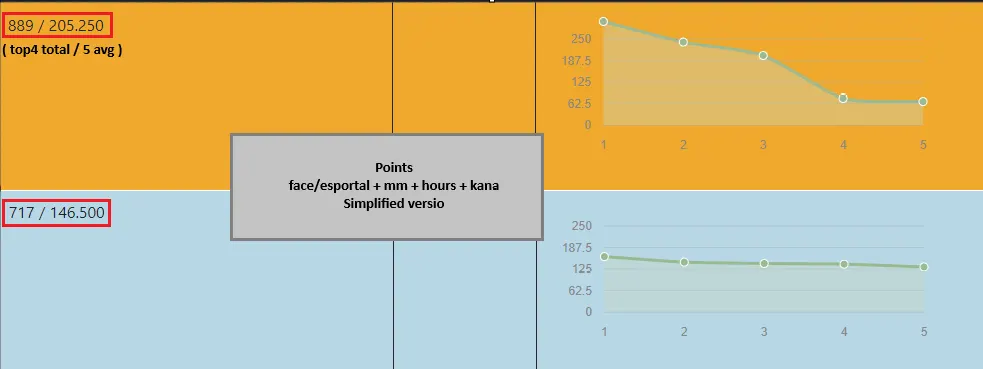
Example: Above is a hardcarry team and below is an even team from a random series level. Scoring 0-320 per/player according to the best five
Tips for teams
It is recommended that the teams consist of players of the same level as possible. Due to the nature of the Kanala League, it is clear that this is not always possible. If there are large differences in level among the players in the team, it is worth making sure that the team’s hardest hitters are also able to participate in the games: the statistics of the team’s best players have a significant impact on the team’s ranking in the league levels, so if the players in question cannot participate, the rest of the team is possibly ranked too high in relation to their own level.
Series levels and the number of series levels varies from season to season. When registering, the team’s previous seasons and league levels in which the team has played in previous seasons are taken into account. Winning the league level of the previous season or finishing last in the level does not automatically mean that the league level changes for the next season, as the number of league levels and the teams’ player rosters may vary from season to season. A team that has played together for a long time can be at a higher league level based on statistics, but the game history together is taken into account. In general, a long shared playing history has a positive effect on performance.
Even at lower league levels, teams can play hard hitters. When creating series levels, this has been taken into account. The calculation aims to estimate how much better the team will be when one hard hitter is included.
I hope this article opened up a little bit of the magic of making CS2 serial levels! CS2 Registration for the autumn season opens on xx.yy.2024 - come along!
See you at Servu!